What Are AI Agents? The Complete 2026 Guide (How They Work, Top Tools & Real Use Cases)
By - Blink AI Team / First Created on - July 1, 2026
Last updated: July 2026
If you've noticed the internet suddenly obsessed with "AI agents," you're not imagining it. In 2025, fewer than 5% of enterprise applications had an agent embedded in them. By the end of 2026, Gartner expects that number to hit 40%. This isn't a minor upgrade to chatbots — it's a fundamental shift in what software can do on its own.
This guide breaks down exactly what AI agents are, how they actually work, the tools worth using right now, and where this technology is headed — without the hype.
What Is an AI Agent, Really?
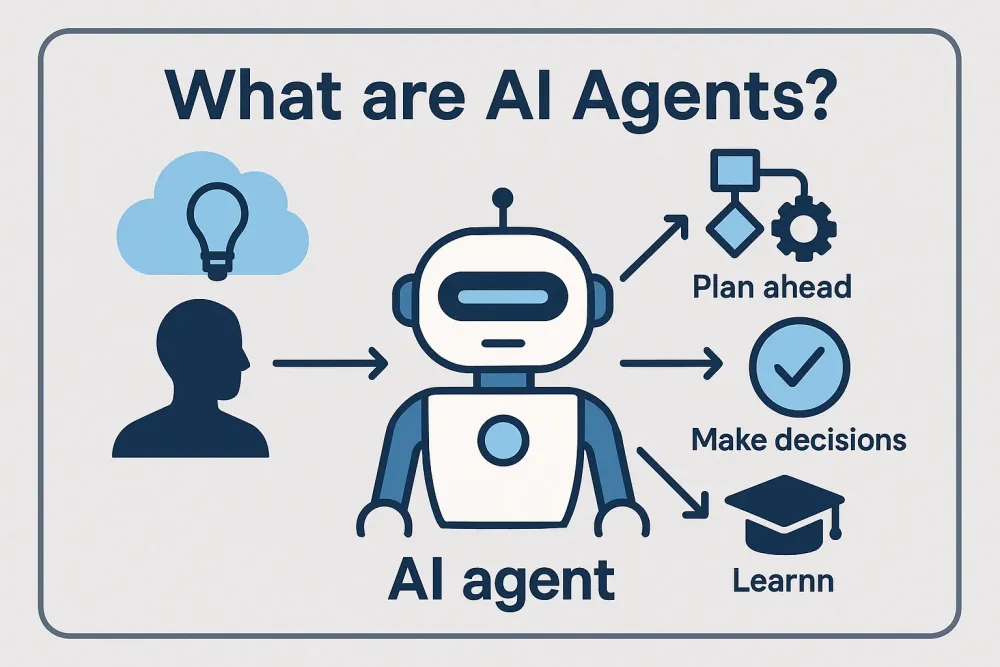
An AI agent is a system that combines a large language model with the ability to use tools, make decisions, and take multi-step actions toward a goal — largely without a human typing out every instruction.
The easiest way to understand the difference is this:
- A chatbot answers a question.
- An AI agent understands a goal, makes a plan, uses tools to execute that plan, checks its own work, and adjusts — often across multiple applications — before reporting back to you.
Think of the difference between asking someone "what's the weather tomorrow?" versus asking them to "plan and book my entire weekend trip." The first is a lookup. The second requires reasoning, sequencing, tool use, and judgment calls along the way. That second scenario is what an agent is built for.
Industry analysts frame this as a shift from instruction-based computing — where you tell a computer exactly how to do something — to intent-based computing, where you simply describe the outcome you want and the agent figures out the steps.
How AI Agents Actually Work
Most modern AI agents are built around a handful of core design patterns that keep showing up across the industry:
- Planning – breaking a goal into smaller, ordered steps
- Tool use – calling APIs, running code, searching the web, querying databases
- Reflection – reviewing its own output and correcting mistakes before finishing
- Memory – retaining context across a task (and sometimes across sessions)
- Human-in-the-loop checkpoints – pausing for approval before high-stakes actions
A big enabler behind the scenes is the Model Context Protocol (MCP) — an open standard that lets agents connect to outside tools and data sources (like a CRM, a database, or a calendar) without custom-built integrations for every single connection. By late 2025, over 10,000 public MCP servers were already live, and MCP has since been handed off to an independent foundation as shared infrastructure.
Single Agents vs. Multi-Agent Systems
The single biggest trend defining 2026 is the move from one general-purpose agent to teams of specialized agents working together — sometimes called "multi-agent orchestration."
Instead of one AI trying to do everything, an orchestrator agent delegates to specialists:
- A researcher agent gathers information
- A coder agent implements a solution
- An analyst agent validates the results
- A reporting agent summarizes what happened
Gartner recorded a 1,445% jump in enterprise inquiries about multi-agent systems between Q1 2024 and Q2 2025 — one of the sharpest adoption curves in recent tech history. Real-world results back up the hype: one staffing platform cut its screening time in half and shrank onboarding from weeks to under 72 hours using this kind of hierarchical agent setup, and Zapier reported deploying 800+ internal agents with 89% company-wide adoption.
Real-World Use Cases Already in Production
AI agents aren't theoretical anymore. Here's where they're doing real work today:
Software development. Coding agents can read a codebase, write and test changes, and open a pull request with minimal supervision — one of the most mature and reliable agent categories so far.
Customer service. Instead of static chatbot scripts, "concierge-style" service agents are grounded in live CRM and logistics data. Some can detect a problem — like a delayed delivery — and resolve it (rescheduling, applying a credit, notifying the customer) before the customer even reports it.
Marketing operations. A modern marketing team might run an "agent team": one agent monitoring competitors and market trends, one drafting on-brand content, one generating supporting visuals, and one compiling weekly performance reports.
IT and security. Governance and security agents now monitor other AI agents for policy violations or unusual behavior, treating agent identities with the same access controls and audit trails as human employees.
Enterprise data. One large manufacturer built an agent that translates plain-English questions into SQL, cutting query time for 50,000 employees by 95%.
The Best AI Agent Tools to Know in 2026
| Category | What it's for | Notes |
|---|---|---|
| Claude (Anthropic) | General-purpose agentic assistant, coding, research | Strong at multi-step reasoning and tool use |
| Claude Code / Cowork | Agentic coding and knowledge-work tasks | Built for delegating real work, not just chat |
| Agentforce (Salesforce) | CRM-native agents | "Headless" access to enterprise data |
| Google Agentspace / Gemini agents | Enterprise workflow agents | Built around the Agent2Agent (A2A) protocol |
| Amazon Q Developer | Legacy code modernization at scale | Used to upgrade thousands of Java apps automatically |
| IBM Watsonx Orchestrate | Cross-platform agent orchestration hub | Connects agents across existing enterprise systems |
The common thread across all of them: they're increasingly interoperable, thanks to open standards like MCP and A2A, rather than locked into a single vendor's walled garden.
The Risks Nobody Should Skip
Agents that can act — not just talk — introduce real risk, and the industry is actively grappling with it:
- Tool poisoning attacks, where a malicious connected server manipulates an agent's behavior through hidden instructions
- Over-permissioned agents that can access more systems or data than they should
- Reliability gaps in less "verifiable" domains — browser-based agents completing multi-step UI tasks are still notably less reliable than agents working in structured, checkable domains like code
- Governance debt — organizations moving fast without clear audit trails or access controls for what their agents are actually doing
The organizations having the most success in 2026 aren't the ones removing humans entirely — they're the ones pairing full automation with deterministic guardrails and human checkpoints at the moments that matter most.
Where This Is Heading
A few signals worth watching for the rest of 2026:
- Agent-to-agent commerce and coordination becoming standard, not experimental, via open protocols
- "Headless" enterprise software, where the interface isn't a dashboard anymore — it's an API surface an agent can operate directly
- New job roles emerging around agent management, oversight, and "context engineering" — designing what information an agent can see, not just what it's asked
- Personal AI agents becoming as common as smartphone apps, handling scheduling, research, and shopping on an individual's behalf
FAQ
Is an AI agent the same as a chatbot?
No. A chatbot responds to messages. An AI agent plans, uses tools, takes multi-step actions, and can complete tasks with little ongoing human input.
Do I need to code to use AI agents?
Not necessarily. Many agent platforms now offer low-code or no-code setup, though building custom, specialized agents still benefits from technical skill.
Are AI agents safe for businesses to use?
They can be, with the right guardrails — access controls, audit trails, and human checkpoints for high-stakes actions. Ungoverned agent deployment is where most real risk shows up.
What's the difference between agentic AI and generative AI?
Generative AI creates content (text, images, code) in response to a prompt. Agentic AI takes that a step further — it plans, acts, and pursues a goal autonomously, often using generative AI as one part of a larger workflow.
AI agents are moving fast — what's true in July 2026 may look different by year's end. If this helped you make sense of the space, share it with someone still asking "wait, what's an AI agent, actually?"